
Son of Philippe & Célestine
Louis Philippe Noisette
1806–1863
Named on a bill of sale before he could walk, raised in his father's Charleston nursery, he lived free without the papers to prove it, and died far from home in Port of Spain, Trinidad.

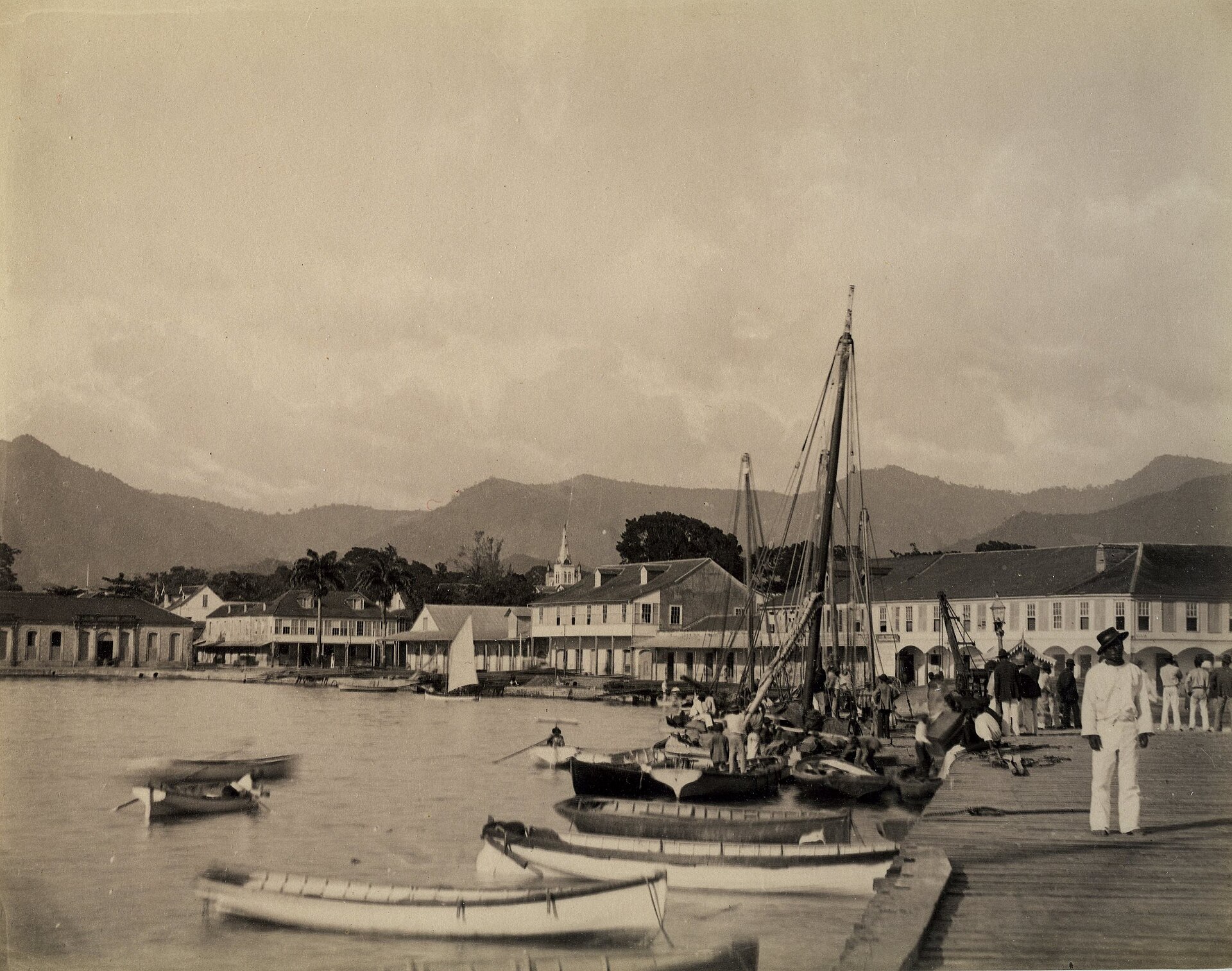
The docks at Port of Spain, Trinidad. Photograph by Félix Morin. Public domain, via Wikimedia Commons.
Louis Philippe was the second son of Philippe Stanislas Noisette and Célestine, and the one whose face the family has kept. For generations his portrait has hung in Noisette homes. Behind it is a life that ran from his father's rose nursery on the Charleston Neck to the harbour of Port of Spain, and two daughters whose families carried his name into the twentieth century.
The family portrait
The face the family kept
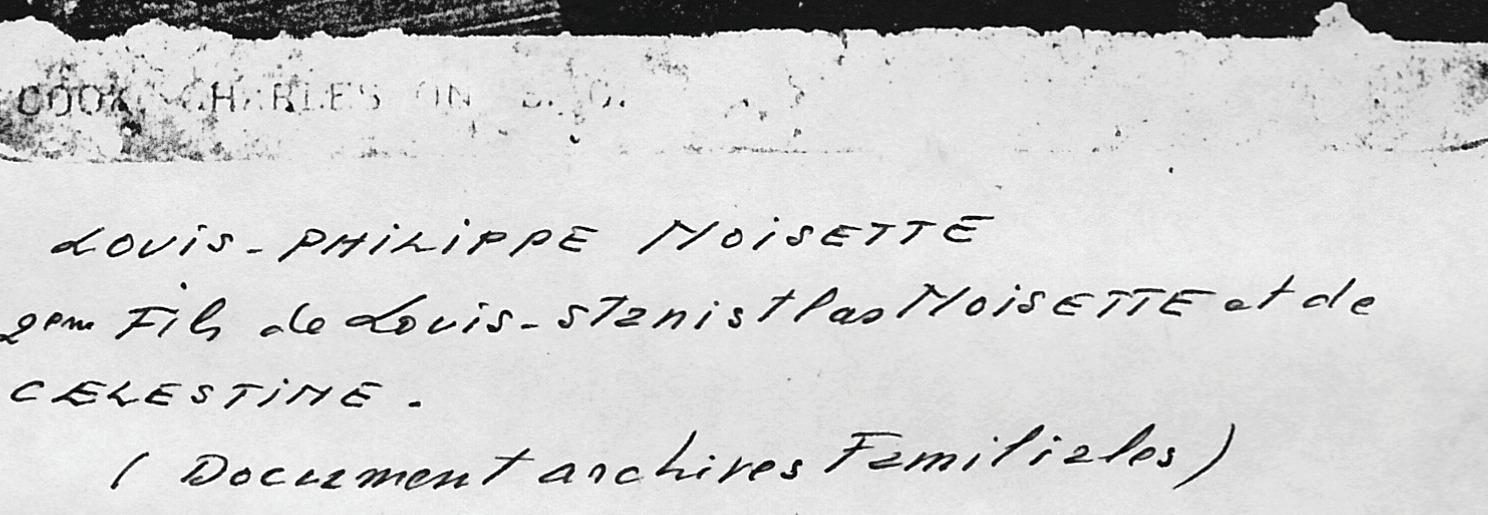
For generations the Noisette family has proudly displayed this portrait. The American Noisettes long believed it had come from their French cousins; the mount, though, is stamped by the studio of George S. Cook of Charleston. On the card, in French, a family hand has written:
Louis-Philippe Noisette, 2nd son of Louis-Stanislas Noisette and of Célestine (family archives).
Cook opened his Charleston studio in 1849 and moved to Richmond in 1880, leaving the studio to his son. The family history dates the photograph to about 1880, but if Louis Philippe died in Trinidad in 1863, it must have been taken in the 1850s or early 1860s, when he was in his fifties.
Noisette family collection; published in the family history, 2011.

1806 to 1807
A child on a bill of sale
Louis Philippe was born in 1806, the second son of Philippe and Célestine, almost certainly in Charleston. He was still a baby when, on 12 September 1807, his father paid $650 for a bill of sale for “Celestine” and her two children, “Phillippe and Alexander”. Recorded on 23 September 1807, it is the earliest document that names him.
The paper was meant to protect the family: proof that no one else could claim or sell them. But it also meant that in the eyes of South Carolina law, Louis Philippe began his life as his own father's property.

Noisette Collection, 2011.
1807 to 1835
Growing up in the nursery
He grew up on the Noisette Farm on the Charleston Neck, beside the botanic garden his father ran: fields of flowers, shrubs and young trees, and the roses his father was raising from John Champneys' seedlings, the roses that became the Noisettes. With his brothers and sisters he worked the nursery and learned the trade, as his father and grandfather had learned it in France.
When he was in his teens, his father petitioned the state legislature to free Célestine and their children. The petition was denied, and he and his brothers and sisters grew up free in daily life but not in law.

Photo: Anna reg, CC BY-SA 3.0 AT, via Wikimedia Commons.
1835 to 1859
Free, without the papers
His father died in April 1835, when Louis Philippe was about twenty-nine. The will declared him and his brothers and sisters Philippe's children and told the executors to take them somewhere they could be made free. The family stayed in Charleston instead, on the farm, living as free people of colour with the protection of their father's friends, although the law still counted them as enslaved.
In 1850 “Louis” is listed with his mother, brothers, sister and sister-in-law in Charleston's tax books for free people of colour. His daughter Ellen Elizabeth was born about 1849. Her mother's name has not come down to us. In 1853 he lost his mother, Célestine, and his elder brother, Alexander, within four days of each other.

Photo: Charles N. Bayless, 1978. Public domain.
The petition of Philippe Noisette's children to remain in South Carolina as free persons of colour, 1859That they were all born where they now live, are attached to the laws of the Country, and very unwilling to be removed.
Background: Noisette Blush Rose, artwork by Andrea Hazel.
The eve of war
Leaving Charleston
By the late 1850s Charleston was closing in on its free people of colour. New laws, tighter policing and talk of forcing them back into slavery drove many to prove their status, find white guardians, or leave the state. In 1859 Philippe and Célestine's children asked the legislature to let them stay where they had been born.
At some point in these years Louis Philippe went to Trinidad. We do not yet know when he sailed or why, but the island made sense for a French-speaking Catholic man of colour: Trinidad had been settled by French families, free people of colour among them, since the 1780s; it was British, and slavery there had ended in 1838.

Photograph by Félix Morin. Public domain, via Wikimedia Commons.
Family
Two daughters
Ellen Elizabeth Noisette (about 1849 to 1891) married Francis “Frank” Sparks Lee. Their five sons were:
- Norman Alexander Crosdell Lee (1870–1949)
- William Adolphus Lee (1872–1958, who died in Los Angeles)
- Francis McKinley Lee (1876–1960)
- Samuel Eugene Lee (married at St. Paul's Episcopal Church, Summerville, in 1906)
- James Hicks Lee (1884–1957)
Their descendants live across America, from Charleston to Detroit and Los Angeles.
Louisa “Dammy” Josephine Noisette (1862 to 28 March 1945), born in Trinidad, married John Henry Wade Edwards and made her life in Charleston. Their children were:
- Henry Edwards (1886–1916)
- Louis Edwards (1891–1927, born in Charleston)
- Lillian Edwards (1900–about 1956, who married Lucius Alonzia Nell)
- James (Jessie) Edwards
Noisette family collection.
Timeline
Louis Philippe's life
- 1806Born, the second son of Philippe Stanislas Noisette and Célestine, probably in Charleston
- 180712 September: named with his mother and brother Alexander on the bill of sale
- 1817About this year his father sends seed to Paris: the Noisette rose
- 1820sHis father's petition to free Célestine and the children is denied
- 18357 April: his father dies; the family stays on the Noisette Farm
- c. 1849His daughter Ellen Elizabeth is born
- 1849–1863Probably the years of his portrait at George S. Cook's Charleston studio
- 1850Listed in Charleston's tax books for free people of colour
- 1853His mother Célestine and brother Alexander die
- 1859Philippe's children petition to remain in South Carolina as free people of colour
- 1862His daughter Louisa Josephine is born in Trinidad
- 1863Dies at Port of Spain, Trinidad
The family tree and descendant report, the family history (Noisette Collection, 2011), and Brigid Wallace, “Preservation of Family: The Noisette’s Journey From Saint Domingue to Charleston, SC, 1780–1860” (MA thesis, Lehigh University, 2026).
By the numbers
One life, two shores
Gallery
Charleston and Port of Spain
The places of Louis Philippe's life. Click any image to see it larger.



Public-domain photographs by Charles N. Bayless (HABS) and Félix Morin; Sword Gates House photo by CharlestonSCwriter, CC BY-SA 4.0; rose photographs CC BY-SA (Geolina163; Cillas).
Research notes
What we know, and what we're still looking for
From the records. The 1807 bill of sale and the 1850 Charleston tax books (cited in Brigid Wallace, “Preservation of Family: The Noisette’s Journey From Saint Domingue to Charleston, SC, 1780–1860” (MA thesis, Lehigh University, 2026)); the family's descendant report (2023) for his death in Port of Spain and his daughters and grandchildren; the family history (2011) for the portrait.
Where the records disagree. The family history dates the portrait to about 1880, but the tree has Louis Philippe dying in 1863, and George S. Cook ran the Charleston studio himself from 1849 to 1880. Either the portrait is earlier than the family thought, or one of the dates is wrong. The French caption on the card names the sitter as Célestine's son.
Still to find. His exact birth date and baptism; the names of Ellen's and Louisa's mothers; when and why he went to Trinidad; and his death and burial in Port of Spain, which may be in the Catholic parish registers or the civil records of Port of Spain. If you can help, log in and use “Suggest a change” on this page, or contact the family editors.
The family today
His descendants
Descendants of Louis Philippe's daughters still gather with the rest of the Noisette family, in Charleston and in France.
Noisette family slideshow by Darrell Noisette.
From the family tree
Family record
Share
- Birth
- Marriage
- Death / burial
- Other
Life events
| Birth | 1806 | Second son of Philippe Stanislas Noisette and Célestine. Year from the family tree; place probable (named on the 1807 Charleston bill of sale). · |
|---|---|---|
| Other event | 12 Sep 1807 | Named as “Phillippe” with his mother Célestine and brother Alexander on the bill of sale recorded 23 Sep 1807 (Charleston District bills of sale, SC Dept. of Archives and History). · |
| Other event | between 1849 and 1863 | Portrait photographed at George S. Cook's studio (family collection). The family history dates it c. 1880. · |
| Residence | 1850 | Listed as “Louis” in Charleston's Free Negro Capitation Books (tax on free people of colour) with his mother, siblings and sister-in-law. · |
| Other event | 1859 | Philippe Noisette's children petition the SC legislature to remain in the state as free persons of colour (family history; Wallace, Lehigh thesis, 2026). · |
| Emigration | before 1862 | Moved from Charleston to Trinidad; his daughter Louisa Josephine was born there in 1862. · |
| Death | 1863 | From the family descendant report (2023). · |
Family
| Parents | Philippe Stanislas Noisette 1773–1835 & Célestine 1777–1853 |
|---|---|
| Siblings |
|
| Partner | Unknown Noisette |
| Children |
|
| Partner | Unknown Noisette |
| Children |
|
Family chart
Loading…
Photos & documents

Family members can log in to see living relatives and suggest corrections. Log in